Journal
Reformer or Mat Pilates: Which Should You Start With?
Mat and reformer are the same method taught two different ways. The question is not which is better in the abstract — it is which one gets a beginner moving well faster. For most people, the answer is the reformer, and the reason is not the one you would guess.
The same method, two settings
Joseph Pilates developed both. The mat work came first — a sequence of exercises using only bodyweight and the floor. The apparatus, including the reformer, came later and was designed to help people perform those same movements correctly when their bodies could not yet do so unassisted.
That history matters, because it inverts the usual assumption. The reformer was not invented as an advanced upgrade. It was invented as help.
Why the reformer is often easier to start on
On a mat, you provide all the resistance and all the support. If your hip flexors are tight or your deep abdominals are not yet switching on, you compensate — and because nothing is holding you accountable, you can repeat that compensation for months.
The reformer gives you feedback. The carriage only moves smoothly when you are moving correctly; jerk it and you feel it immediately. The springs can support a movement you are not yet strong enough to do unaided, and the straps and footbar hold your limbs in a defined path.
- Adjustable resistance — the same exercise can be made lighter or heavier in seconds, so a mixed-level class genuinely works.
- Support where you need it — springs can take weight off a movement rather than only adding to it.
- Immediate feedback — the carriage tells on you when your control slips.
- Easier on the joints — much of the work happens lying down, with the spine supported.
Where mat work genuinely wins
Mat Pilates is cheaper, needs no equipment, and travels with you — you can do it in a hotel room or at home between sessions. It also demands more raw stability precisely because nothing is helping, which makes it valuable once you have the fundamentals.
The honest summary: mat is harder to do well and easier to do badly. Reformer is harder to do badly.
So which should you start with?
Start on the reformer if you are new to exercise, sit at a desk most of the day, are returning after an injury or pregnancy, or have tried mat classes before and never felt much beyond the effort.
Start on the mat if budget is the deciding factor, or if you already have a strong movement background and want to add Pilates principles to it.
In practice, most people who begin on the reformer end up doing some mat work anyway, because the reformer teaches them what the movement is supposed to feel like — and they can then find that feeling without the machine.
What about the other apparatus?
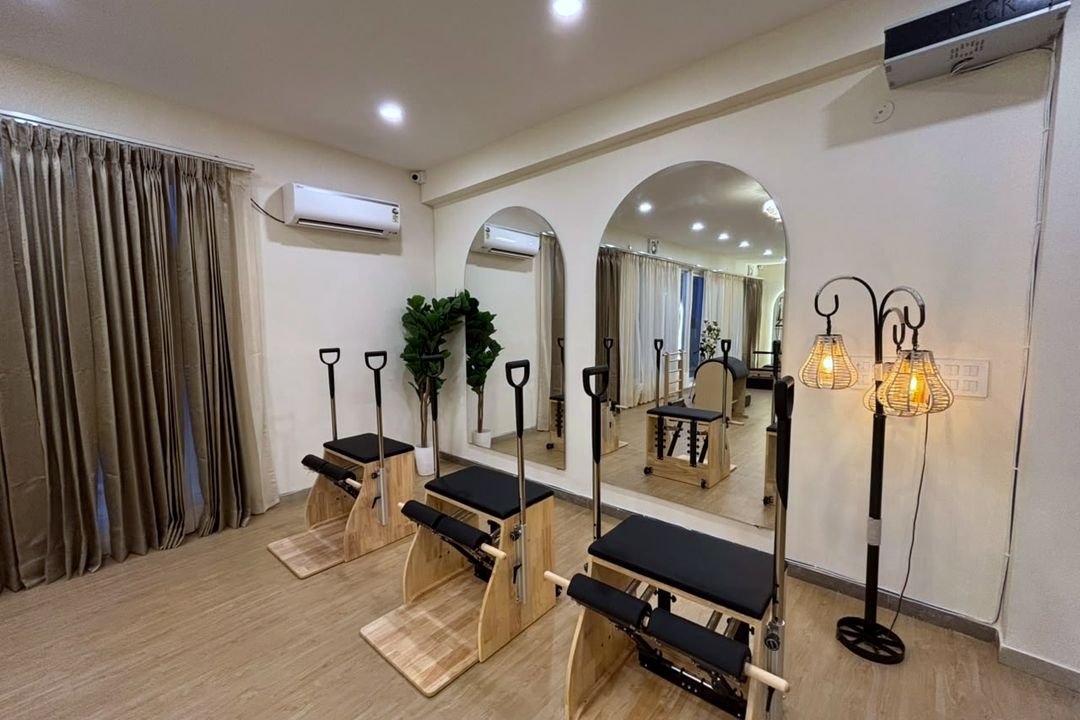
A full studio has more than reformers. The Cadillac, the Wunda chair, the ladder barrel and the spine corrector each isolate things the reformer cannot, and a good instructor moves you between them as you progress. If a studio has only reformers, your programme has a ceiling — usually somewhere around month three, which is exactly when things get interesting.
This is worth checking before you commit anywhere. A gym with one reformer in the corner is not a Pilates studio, however the timetable is worded.
Try it on the machine
Reading about the reformer only goes so far. Come in for a trial session and we will show you what the springs actually feel like.
Book a trial session